The Youngest Branch at Middelharnis
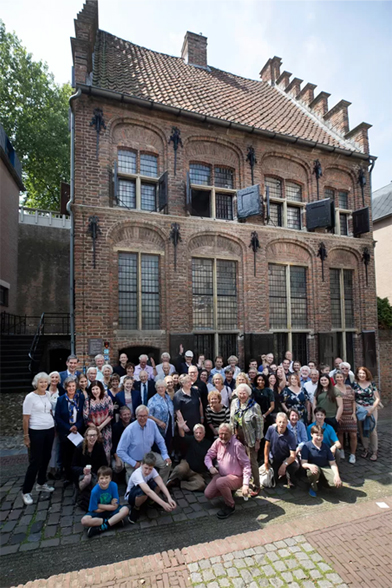
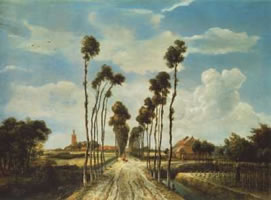
Image: “Laantje van Middelharnis” (Lane at Middelharnis), Meindert Hobbema.
At Middelharnis, more than in any other town of our country (the Netherlands), we find abundant remembrances to the Kolff family. For more than two centuries members of the Kolff family have lived here. In certain periods even several households at the same time. They worked there, took on several tasks, in short they did what they could find to do. This article serves to introduce the diversity of those activities such as their entrepeneurship. With that it also shows the amazing recourcefullness and flexibility of the ‘elite’ in a small provincial town that was Middelharnis.
The activities of our family at the island of Overflakkee start in 1710, when Cornelis Kolff (C Xc) (1685-1759) says farewell to The Hague and settles at Middelharnis at notary public. He would also be secretary and receiver of taxes, as well as bailiff, of the manor of Middelharnis. He did not stop at these gouverning activities: rather he spread his risks and invested for example in a ship. However, after his wife died in 1738 he left the island and moved to Maassluis, his place of birth.
His son Gualtherus (XIc) (1711-1789) took over the function of notary public and just like his father became secretary and bailiff at Middelharnis. In the 1720’s and 1730’s he had been able to practice these functions at the nearby manor Dirksland. From time to time he was appointed in functions of all kind in boards of polders and no doubt he obtained property here and there. Also Gualtherus did not place all his bets on one card. He participated in a shipping company and in 1749 we find him to be leaseholder of the Middelharnis fish market. Such entrepeneurship required capital. His financial risk as leaseholder was that he was obliged to buy all the fishers’ catches and then had to see how to get his investments and costs back from the buyers. Turnover was high; all of the fish that entered the Goereese Gat had to be put to market either at the fish market of Middelharnis or at that of Hellevoetsluis.
| * Sub-title of this article at De Colve has been: “Wat je hand vindt om te doen – De Jongste Tak te Middelharnis” which I translated freely as “Things one finds to do – The Youngest Branch at Middelharnis.” |
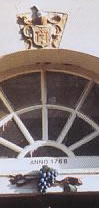
Gualtherus’ sons Adrianus Quirinus (CB XIIf) (1745-1826)Middelharnis: Kolff swan and grapes and Lambertus (CC XIIg) (1749-1823) complemented, just like their grandfather and their father before them, public with private entrepreneurship. Priorities could differ between the two. Apart from being appointed as juror, sheriff, bailiff, secretary, treasurer and mayor, secretary and dike-reeve of polders, notary public and commissioner of ground-taxes, the brothers were also ship owners. As Lambertus was mainly regent and gouvernor, Adrianus Quirinus was more the entrepeneur and a man of Enlightenment. In 1768 the latter bought the big house at the Voorstraat, with warehouse and carriage houses, as well as the wine company already established there, and the grounds that were part of it. Still today one can see at the door this year inscribed over a sculptured bunch of grapes, and above this door the coat of arms of the Kolff family. Apart from him being merchant he also had income from agriculture. Notable are his philantropical and cultural activities. Let me start in writing about Adrianus Quirinus’ societal interest and after that about his economical activities, which would lead – in the course of a number of generations – to some kind of collective company.
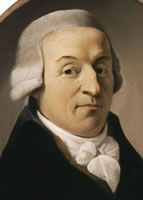
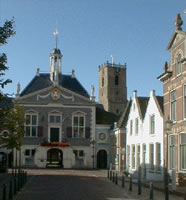
Image: Townhall Middelharnis (presently Rien Poortvliet Museum)
In 1810, to start with the first, he was one of the founders of the Middelharnis-Sommelsdijk department of the MiddelharnisMaatschappij tot Nut van ’t Algemeen (Society for Public Welfare), which dated from 1784 and was soon after active all over the country. At this department the atmosphere must have been quite liberal, contrary to other parts in the Netherlands which later so often showed segregation over the denominations. One of the founders and active members was the (Catholic) pastor of Oude Tonge, who immediately suggested to appoint the (Protestant) minister of his village; a suggestion that was accepted without balloting. Adrianus Quirinus became the first treasurer until 1819, the year of his golden wedding jubilee, when he resigned because of old age. He was then appointed honorary member thanks to him “being a model in accuracy and ecellent bookkeeping”. Whether he ever addressed the members, I do not know. He did show his progressiveness by asking in 1812 the medics of his fellowship to check one of his cows, that “was maybe infected by cow pox”, this only fourteen years after the publications in England by Edward Jenner on the advantages of vaccination.
Already in the 1770’s he had his children treated against smallpox by ‘variolation’, which shows that he was a man with great confidence in modern science. Three years after Adrianus Quirinus’ request to the medics the department of the Maatschappij tot Nut van ’t Algemeen ordered 200 leaflets to be handed out across the island. These leaflets treated the on the advantages of vaccination of cows against cow pox. An initiative he must have supported wholeheartedly.
One of his children, Cornelis (CBB XIIIf) (1776-1830), who in 1809 already once leased the patented Bank van Leening at Middelharnis, succeeded him as treasurer. He would keep that function until his death in 1830. As bookkeepers or treasurers, for instance also in the boards of the polders, the Kolffs of Middelharnis enjoyed great confidence. Sometimes one may still hear the description of this branch of the Kolffs of being ‘economical’, a result of the reputation that started in those years? Cornelis’ son Gualtherus Constantinus Marius (CBB XIVi) (1819-1890), “in difficult times always a man of deeds”, became treasurer of the Maatschappij tot Nut van ’t Algemeen in 1848 and held that position until 1862. Several successors followed but they were not Kolffs. But in 1895 “the department returned to her former love and trusted C. Kolff A.Cz. (CBB XVk) (1860-1923) with the care of the treasury as well as the accounting of the savings bank. ‘Young Cor’ (G.C.M. was his uncle), who now [1910] has proven, for many years, to give honour to his dynasty to try to be equal in accuracy and policy to the first treasurer.” This sound like he still had to wait for the highest honour, but nobody ever questioned his position.

Image: ANWB (Neth. Cyclists [read: Motorists] Association) sign at the house in the Voorstraat mentioning: Great 18th century residence of the prominent Kolff family, ship owners and wine merchants (etc.).
Literature: Han Boomsma, ‘Terugblik in het grijs verleden: het huis met de druiventros’, in Eilanden-Nieuws, 15-02-1972. Nelleke Manneke, ‘Kolff in zeven eeuwen’, Rotterdam 2001. K. Vos (ed.), Gedenkschrift t.g.v. het honderd-jarig bestaan van het departement Middelharnis-Sommelsdijk der Maatschappij tot Nut van ’t Algemeen, Middelharnis 1910. J.A. Wittekoek, ‘Een terugblik op de vroegere fa. Kolff te Middelharnis’, in Eilanden-Nieuws, 08-01-1993.
Shortly after the latters’ death in 1830, when his son succeeded him, this enterprise of the Nut van het Algemeen went bankrupt, caused by financial insecurities due to the Belgian Revolt.
Inserted in the Gedenkschrift (Memoir) of the Nut van het Algemeen is: “The savings bank has been murdered by the Belgians.” The members of the department raised and funded the shortage of 500 guilders.
When in 1849 the Nut van het Algemeen decided to raise a new savings bank the already mentioned Gualtherus Constantinus Marius (CBB XIVi, 1819-1890) became one of the deputy directors. As mentioned in 1985 ‘Young Cor’ became treasurer and accountant of this bank and soon followed a period of great prosperity. De facto this savings bank, at least the part of the treasury, soon became part of the conglomerate of the Firma Wed. C. Kolff, the old company of Adrianus Quirinus (CB XIIf) (1745-1826). With an account on this versatile enterprise I hope to continue in Part 2 of this article.
Dirk Kolff, archivist
(translation by Marius Kolff)
See also Links: History & Biographies (Middelharnis) and 15 Mayors.
Literature: Han Boomsma, ‘Terugblik in het grijs verleden: het huis met de druiventros’, in Eilanden-Nieuws, 15-02-1972. Nelleke Manneke, ‘Kolff in zeven eeuwen’, Rotterdam 2001. K. Vos (ed.), Gedenkschrift t.g.v. het honderd-jarig bestaan van het departement Middelharnis-Sommelsdijk der Maatschappij tot Nut van ’t Algemeen, Middelharnis 1910. J.A. Wittekoek, ‘Een terugblik op de vroegere fa. Kolff te Middelharnis’, in Eilanden-Nieuws, 08-01-1993.