From Gelre to Holland
From Gelre to Holland
‘Identity’ has become a magical word in the past years. For those who are a member of our association, or who are fascinated by history, it has always been clear: we belong to this family, it has something to do with whom we are; it is a part, probably only a small part, of our identity. But then again, who are we? Hollanders, one could say, or at least spread out of Holland over other provinces in our country (the Netherlands) and even beyond. This question how we became Hollanders has been discussed before: “Kolffs are people from the rivers” was the answer. But how did we become Hollanders?
Wouter Kolff (1644-1705) and Petronella van Duren (1644-1712) married in the church of Beuningen, close to Nijmegen, in the summer of 1671. They were children from Nijmegen, baptized there only fourteen days after one another. Maybe they already knew one another from school, or had played as young children along the quays of Nijmegen. I think they were a good match…
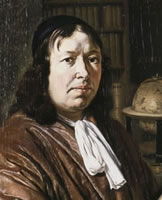
Ds. Wolter (Gualtherus) Kolff
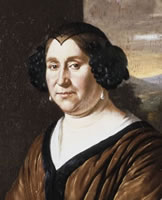
Petronella van Du(y)ren
Wouter came from a family of boatsmen; his father has been master of the guild. When Wouter was only nine years old his father had died. His mother, Maria, was a woman with style and character. She was a Van Heteren, a somewhat noble family that had become burghers at Nijmegen. She knew how to handle things. Just before her husband had died she had become the city’s undertaker (‘lijkbidster’). This meant that when people died she did the notifications and that she took care of the proper funeral ceremonies in church. This required good contacts with ministers, sextons, and gravediggers. It also required subtleness as well as business skills. She must have possessed all of these. Probably thanks to her network Wouter, who could learn well, could go to the Nijmegen high school (gymnasium). After that he studied at the Kwartierlijke Academie of Nijmegen. There he pleaded in March 1664 a dispute on a then current scientific subject: the relation between soul and body. For this the Council of Nijmegen granted him an allowance of 36 guilders. Thereafter he studied theology which he concluded at Leiden in 1667-68.
Petronella van Duren came from a large family of Nijmegen silver-smiths. It was common amongst them to own small companies and houses. Unlike the Kolffs a number of Van Durens were members of the consistory. From later reports we know that Petronella was an energetic woman: often on her way to one of her three sons and extreemly active when her only daughter, who was rather frivolous, threatened to harm the reputation of the family.
After Wouter had been examined as candidate in theology by the classis of Nijmegen he reported himself in april 1670 at the classis of Zaltbommel, as a candidate for the ministry (so-called proponent). Shortly after he got appealed at Vuren en Dalem, the utter most western community of Gelre, on the river Linge and across from Gorinchem, in Holland. It is to say at least peculiar that he never showed himself at Vuren, where the church stood, and also never came to the meetings of the classis at Zaltbommel.
Perhaps at the beginning he could be apoligized because of his marriage. Only in April 1672 he could be officially taken in as a member of the classis and it seems he was doing his work properly. But not for long, for in the summer of that same year Wouter and Petronella were neither at Dalem nor at Vuren. The ‘Rampjaar*’ rampaged the Nederbetuwe.
French horsemen looted the no man’s land between the State (Republican) troops at Gorinchem and those of Turenne at Zaltbommel. Safety could only be found within the Dalem Gate of the Holland town of Gorinchem. Petronella was pregnant. It is likely that the young couple found refuge with Rev. Georgius de Mey and his wife and the baby was born there. We know that the baby was baptized Georgius Justinus at Gorinchem on August 12, 1672, by Rev. De Mey. Both names were new to both the fathers’ and the mothers’ families. We can clarify Georgius, but Justinus has so far remained a mystery. It is obvious that the parents had reason to be thankful to a number of people. Likely to be people from Holland. The energetic abilities of Petronella must have had something to do with this. Already the next year Wouter got appointed at Noordeloos’ beautiful, big church; Noordeloos belonging to the classis of Gorinchem.
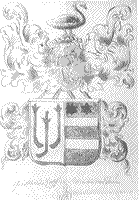
Image: Coat of Arms, Alliance Kolff-van Duren (van Duyren)
(taken from Kolff in Zeven Eeuwen, p. 22)
Six years later they went further west: from Noordeloos to Maassluis. The couple would remain at Maassluis for the rest of their lives. Would they have spoken with a Nijmegen dialect at home in Maassluis? I think something from Nijmegen has always remained with us thanks to this couple Kolff-van Duren. It is the swan, as tarpaulin with our coat of arms. In many a Nijmegen story the swan is being honoured as the bird that came down along the river Rhine and landed at the quay of the river Waal, just there where Nijmegen is now situated. Of the Coat of Arms of the Alliance of Wouter and Petronella in 1671, the year of their marriage, a copy is kept at the family archives. It hardly resembles our present coat of arms, but the swan is already there. That must have been a swan from Nijmegen that travelled along to Maassluis.
* Rampjaar: Dutch known expression for the year 1672 (transl. ‘Disaster Year’) when the Republic of the United Netherlands was declared war and got attacked by England, France, Münster and Cologne.
See also: Biographies: 1939-1950: J.M. Kolff (4)